Introduction
What is spatial audio? This is one of the most searched questions in audio technology right now, and it is easy to see why. You have probably seen the term “spatial audio” appear on your iPhone, your AirPods, your Netflix app, your Apple Music subscription, or your new pair of headphones, and wondered what it actually means and whether it genuinely makes any difference to how your music, movies, and podcasts sound.
The answer to what spatial audio is is simpler and more exciting than most people expect — it is a technology that transforms how sound is delivered to your ears, creating a three-dimensional listening experience that makes music, movies, and games feel dramatically more immersive and realistic than traditional stereo audio. Understanding what is spatial audio and how it works does not require any technical background — this guide explains everything in plain, simple language that anyone can follow.
By the time you finish reading this article, you will have a thorough and confident understanding of what is spatial audio, why it matters, which devices and services support it, and how to make sure you are getting the best spatial audio experience from your own devices right now.
What Is Spatial Audio — The Simple Definition
The simplest possible answer to what is spatial audio is this — it is audio technology that makes sound appear to come from specific locations in three-dimensional space around you, rather than simply from the left and right channels of a traditional stereo system.
When you listen to a song in regular stereo through headphones, all the instruments and vocals are positioned somewhere on a flat left-to-right plane directly in front of you — the drums might be slightly left, the guitar slightly right, and the vocals in the center, but everything exists on the same horizontal level with no sense of height, depth, or the kind of natural three-dimensional space you experience when you hear live music in a real room.
What is spatial audio changes this completely — it uses advanced audio processing technology to place sounds anywhere in a full three-dimensional sphere around your head, including above you, below you, in front of you, behind you, and at any point in between. The result is a listening experience that feels dramatically more realistic, more immersive, and more emotionally engaging than anything traditional stereo audio can deliver.
What Is Spatial Audio — The History and Background
To fully understand what is spatial audio in 2026, it helps to know where this technology came from and how it has developed into the mainstream consumer feature it is today. Spatial audio technology has existed in professional cinema and broadcasting for decades — movie theaters have used multi-channel surround sound systems since the 1970s, and formats like Dolby Surround and DTS have been standard in home theater systems since the 1990s.
However, the traditional approach to spatial audio in cinema and home theater required multiple physical speakers placed around the room at specific positions — typically front left, front right, center, surround left, surround right, and subwoofer in a standard 5.1 configuration.
What is spatial audio in the modern consumer context is the ability to deliver this same sense of three-dimensional sound through just two speakers or, more remarkably, through a standard pair of headphones — using psychoacoustic signal processing rather than multiple physical speakers to create the perception of three-dimensional sound. This breakthrough in delivering convincing spatial audio through headphones is what has made what is spatial audio such an important and rapidly growing topic in consumer audio technology.
What Is Spatial Audio — How the Technology Actually Works
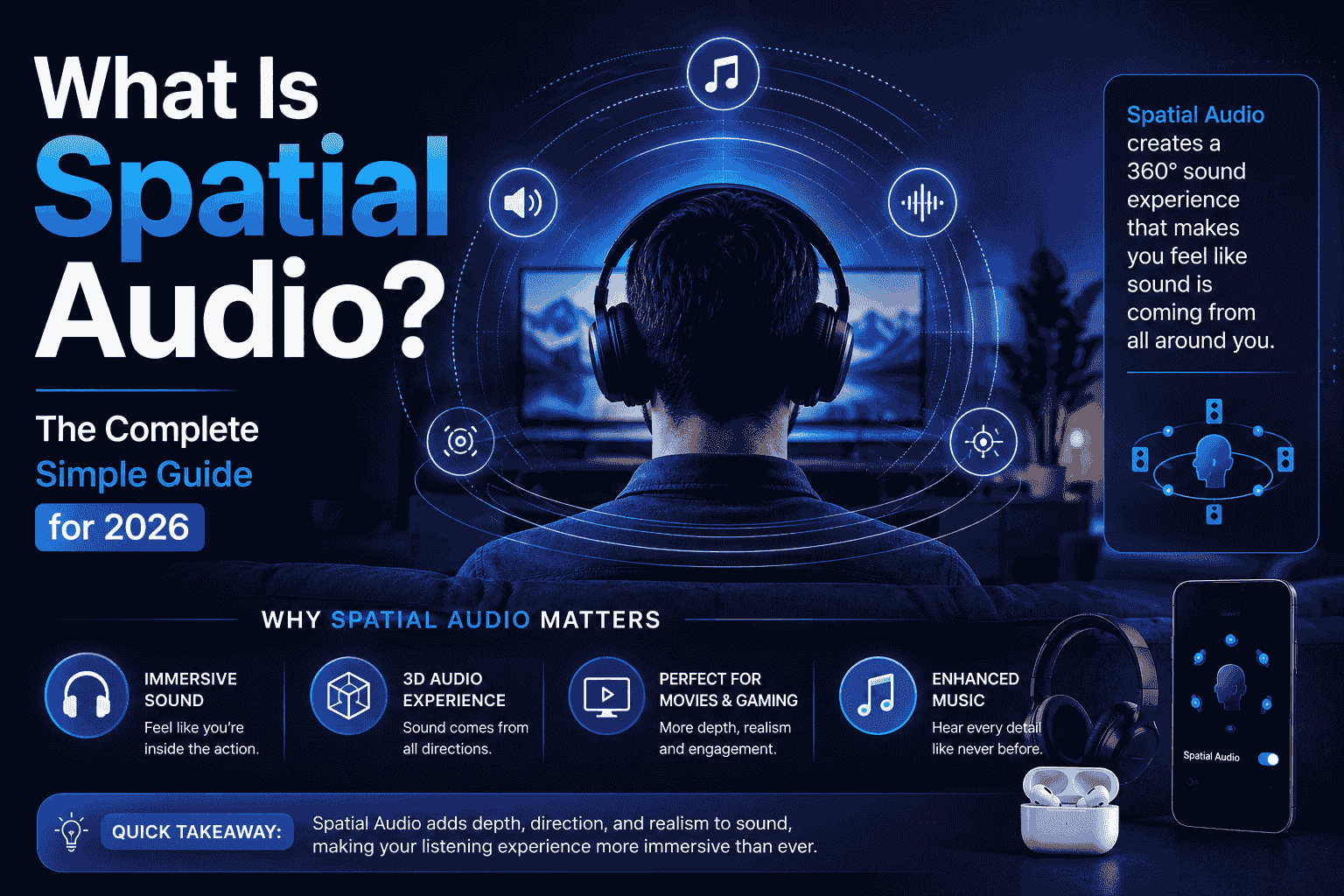
Understanding exactly how what is spatial audio technology creates the perception of three-dimensional sound through two headphone drivers requires a brief explanation of psychoacoustics — the science of how human hearing works. Your brain uses several sophisticated cues to determine where sounds are coming from in the real world.
The most important of these cues is the difference in timing between when a sound reaches your left ear and your right ear — a sound from your left arrives at your left ear fractionally before your right ear, and your brain uses this tiny timing difference to calculate the horizontal direction of the sound source. Your brain also uses the way your outer ear shape and head geometry modify the frequency content of sounds coming from different directions — sounds from above or below are subtly colored differently by the physical shape of your ear before they reach your ear canal.
What is spatial audio technology exploits both of these psychoacoustic principles by applying mathematical models called Head-Related Transfer Functions, or HRTFs, to audio signals. HRTFs mathematically simulate the timing and frequency modifications that your ears and head would apply to sounds coming from specific three-dimensional positions, and when these processed signals are played through headphones, your brain interprets the result as sound coming from those positions in three-dimensional space — even though the sound is actually coming from tiny drivers positioned directly in your ears.
What Is Spatial Audio on Apple Devices — AirPods and iPhone
For most people who first ask what is spatial audio, the question arises because they saw the term appear on their iPhone, iPad, or AirPods settings. Apple introduced spatial audio support for AirPods Pro and AirPods Max in 2020, and has since expanded it to a growing range of AirPods models and expanded the number of apps and services that support it. On Apple devices, what is spatial audio means two distinct things.
The first is spatial audio for video content — when you watch a movie or TV show on Apple TV+, Netflix, Disney+, or another supported streaming service through AirPods, the spatial audio processing positions the different audio elements of the soundtrack in three-dimensional space around your head, creating a cinematic surround sound experience through just a pair of wireless earbuds.
The second is spatial audio for music — when you listen to Dolby Atmos music tracks on Apple Music through compatible AirPods, the spatial audio processing creates a more open, three-dimensional soundstage that makes the music feel less confined to the space between your ears and more like being in the room with the musicians. Apple’s implementation of what is spatial audio also includes dynamic head tracking — sensors in compatible AirPods detect when you move your head and adjust the spatial audio position in real time so that the sound source appears to remain fixed in space as your head moves, exactly as it would with real-world sound sources.
What Is Spatial Audio on Spotify and Music Streaming
What is spatial audio in the context of music streaming is a question that more and more music listeners are asking as major streaming platforms add spatial audio support to their catalogs. Spotify, Apple Music, Amazon Music Unlimited, Tidal, and several other major streaming platforms now offer music mixed specifically in spatial audio formats — primarily Dolby Atmos — that sound dramatically different from traditional stereo mixes when played through compatible headphones or speaker systems.
When you listen to a Dolby Atmos music track on Apple Music through compatible AirPods, for example, you are experiencing what is spatial audio applied to music — the producer and mixing engineer have deliberately positioned different instruments, vocals, and audio elements at specific locations in three-dimensional space around the listener, and the spatial audio processing in your AirPods translates these positions into a convincing three-dimensional listening experience.
Not every song on these platforms has a spatial audio version — the mixing engineer has to create a specific spatial audio mix of each track, which takes additional time and expertise. However, the number of spatial audio music tracks available across major streaming platforms has grown into the tens of millions and continues to grow rapidly as more artists and producers embrace the format.
What Is Spatial Audio on Netflix and Video Streaming
What is spatial audio in the context of video streaming is perhaps its most immediately impressive and accessible application, because the combination of cinematic visuals with three-dimensional spatial audio creates a dramatically immersive viewing experience that genuinely rivals going to a movie theater. Netflix, Apple TV+, Disney+, HBO Max, Amazon Prime Video, and most other major video streaming platforms support spatial audio through Dolby Atmos or similar formats for a significant portion of their content libraries.
When you watch a movie or TV show with Dolby Atmos audio through compatible headphones on a supported device, what is spatial audio manifests as sounds that appear to come from specific locations in the scene — a helicopter that passes overhead sounds like it is actually above you, rain that falls in a scene sounds like it is around you rather than in front of you, and dialogue from a character off-screen sounds like it is coming from the direction the character is positioned relative to the camera.
This positional audio information is embedded in the Dolby Atmos soundtrack by the movie’s audio engineers during post-production, and the spatial audio processing in your headphones or home theater system translates these embedded positions into the three-dimensional experience that makes what is spatial audio so compelling for movie and TV watching.
What Is Spatial Audio in Gaming — How It Gives You an Advantage
What is spatial audio in gaming is one of the most practically impactful applications of this technology, because spatial audio in games is not just about immersion and enjoyment — it can provide a genuine competitive advantage in online multiplayer games. Traditional stereo audio in games positions all sounds on a flat left-to-right plane, which limits your ability to determine the precise location of in-game sounds to a horizontal axis only.
What is spatial audio in gaming adds height information to this positional audio, allowing you to hear whether an approaching enemy is on the same floor as you or above or below you in a multi-story building, whether a sound is coming from directly in front of you or slightly elevated, and how close or far a sound source is based on its apparent distance in three-dimensional space. In competitive first-person shooter games, this additional positional information can be the difference between reacting to a threat in time and being eliminated before you know what direction the threat came from.
PlayStation 5’s Tempest 3D Audio, Microsoft’s Windows Sonic and Dolby Atmos for headphones, and various gaming headset spatial audio implementations all represent different answers to what is spatial audio in the gaming context.
What Is Spatial Audio — Dolby Atmos vs Apple Spatial Audio vs Sony 360 Reality Audio
What is spatial audio is not a single technology but rather a category that encompasses several different proprietary implementations developed by different companies. Understanding the differences between the major spatial audio formats helps you choose the right devices and services to get the best experience.
Dolby Atmos is the most widely supported spatial audio format across both music and video streaming platforms — it is available on Apple Music, Amazon Music Unlimited, Tidal, Netflix, Disney+, and dozens of other services. Apple Spatial Audio is Apple’s implementation of spatial audio processing for AirPods and compatible Apple devices — it uses Dolby Atmos content but applies Apple’s own head-tracking and HRTF processing to deliver the three-dimensional experience.
Sony 360 Reality Audio is Sony’s proprietary spatial audio format for music, available through Amazon Music and several other streaming platforms, which positions audio objects in a spherical sound field around the listener using Sony’s own HRTF processing. Samsung’s new Eclipsa Audio is the newest major entry into the what is spatial audio format landscape, offering an open and royalty-free alternative to Dolby Atmos that Samsung and Google are actively promoting as a standard for the Android ecosystem. Each of these formats represents a different answer to what is spatial audio from a different corner of the technology industry.
What Is Spatial Audio — Does It Actually Sound Better?
One of the most honest and practical questions that people ask when learning what is spatial audio is whether it genuinely sounds better or whether it is primarily a marketing term designed to sell new devices and subscriptions. The honest answer is nuanced — spatial audio genuinely sounds dramatically different from traditional stereo audio, but whether it sounds better depends on the quality of the specific mix, the content type, and individual listener preferences.
For movies and TV shows, the answer is almost always yes — what is spatial audio adds a dimension of immersion and realism to cinematic audio that makes a genuinely noticeable and enjoyable difference to the viewing experience. For gaming, the answer is also clearly yes — what is spatial audio provides both an immersive benefit and a practical competitive advantage through improved positional sound.
For music, the answer is more personal — many listeners find that spatial audio music mixes feel more open, more spacious, and more emotionally engaging than traditional stereo mixes, while some audiophiles prefer the intentional stereo imaging of classic recordings and find spatial audio remixes less faithful to the original artistic intent. The only way to know whether what is spatial audio sounds better to you personally is to try it — and most of the major streaming platforms that offer spatial audio content allow you to switch between spatial and standard audio versions easily for direct comparison.
What Is Spatial Audio — Which Devices Support It?
Understanding what is spatial audio device compatibility helps you determine whether you need new hardware to enjoy spatial audio or whether your existing devices already support it. On the Apple side, AirPods Pro (first and second generation), AirPods Max, AirPods 3, and several newer AirPods models all support what is spatial audio when used with compatible Apple devices running recent versions of iOS, iPadOS, or macOS.
On the Android side, Samsung Galaxy Buds 3 Pro and several other Samsung earbuds support spatial audio through both Dolby Atmos and the new Eclipsa Audio format. For home listening, any soundbar, home theater receiver, or speaker system with Dolby Atmos support delivers what is spatial audio for video content, with the quality of the spatial audio experience depending on the number and positioning of speakers in the system.
On PlayStation 5, the Tempest 3D Audio engine delivers what is spatial audio through any stereo headphones connected to the DualSense controller, making spatial audio for gaming accessible without any special headphone purchase on that platform. On Xbox, Dolby Atmos and Windows Sonic for headphones deliver what is spatial audio through compatible headsets and headphones.
What Is Spatial Audio — How to Enable It on Your Devices
Now that you understand what is spatial audio, enabling it on your own devices is straightforward once you know where to look. On iPhone and iPad with compatible AirPods, go to Settings, then tap your AirPods name, and ensure that Spatial Audio is enabled — you can also toggle Head Tracking on or off from this menu. On Apple Music, spatial audio plays automatically for Dolby Atmos tracks when you have compatible headphones connected — you can verify this by checking the Dolby Atmos badge that appears in the now-playing screen for supported tracks.
On Netflix, select a title with Dolby Atmos audio (indicated in the title details), ensure your device and audio output support Dolby Atmos, and the spatial audio experience activates automatically during playback. On PlayStation 5, go to Settings, then Sound, then Audio Output, and enable 3D Audio for headphones — the PS5 also includes a personalization feature that measures your individual HRTF profile for more accurate what is spatial audio positioning.
On Android devices with compatible Samsung earbuds, the Galaxy Wearable app includes spatial audio settings that allow you to enable and customize the what is spatial audio experience for both music and video content.
What Is Spatial Audio — Common Misconceptions Cleared Up
Several persistent misconceptions about what is spatial audio are worth addressing directly to ensure you have an accurate understanding of the technology. The first misconception is that what is spatial audio requires special headphones to work at all — in fact, while dedicated spatial audio hardware delivers the best experience, Apple’s Spatial Audio works through any connected headphones on supported Apple devices, and PlayStation 5’s Tempest 3D Audio works through any stereo headphones.
The second misconception is that all music on spatial audio platforms is mixed in spatial audio — in reality, only a portion of each platform’s catalog has a dedicated spatial audio mix, and tracks without a spatial audio version play in standard stereo regardless of your hardware and settings. The third misconception is that what is spatial audio and surround sound are the same thing — they are related but different, with traditional surround sound requiring multiple physical speakers at specific positions while spatial audio delivers a convincing three-dimensional experience through just two headphone drivers using psychoacoustic processing.
The fourth misconception is that what is spatial audio only applies to entertainment content — in fact, spatial audio technology is also being applied to communication applications, video conferencing, and even mental wellness audio content that uses three-dimensional sound environments for relaxation and focus.
What Is Spatial Audio — The Future of Three-Dimensional Sound
What is spatial audio today is just the beginning of a technology trajectory that will continue to develop and improve significantly over the coming years. Personalized HRTFs — spatial audio processing customized to the individual shape of each listener’s ears and head — are becoming increasingly available in consumer devices, with Apple’s AirPods Pro already including basic personalization and more sophisticated implementations expected from multiple manufacturers throughout 2026 and 2027.
AI-generated spatial audio remixes are emerging as a technology that can automatically create spatial audio versions of legacy stereo recordings without requiring a human mixing engineer to manually reposition every audio element — opening up the prospect of what is spatial audio versions of classic recordings from any era of music history.
Real-time spatial audio processing for communication applications — video calls, virtual meetings, gaming voice chat — is improving rapidly, with spatial audio positioning of different speakers in a video call making it easier to distinguish and follow multiple simultaneous voices. The future of what is spatial audio is one where three-dimensional audio is the expected standard for all content types and all listening scenarios, rather than a premium feature limited to specific content and specific hardware.
Final Thoughts
You now have a thorough and confident understanding of what is spatial audio — it is a technology that uses psychoacoustic processing to create the convincing perception of three-dimensional sound through headphones or speaker systems, making music more spacious and immersive, making movies and TV shows more cinematic and realistic, and making games more engaging and practically useful for competitive play.
What is spatial audio in 2026 is a mature, widely supported technology available across the most popular streaming platforms, on hundreds of millions of compatible devices, and in multiple competing formats that all share the same fundamental goal of delivering more realistic and engaging three-dimensional audio to listeners everywhere. Whether you are listening on AirPods with Apple Music, Samsung Galaxy Buds with Dolby Atmos content, or a PlayStation 5 with Tempest 3D Audio, what is spatial audio is already available on your existing devices and waiting for you to discover and enjoy it.
Visit cloudconnectedaudio.org for more in-depth guides on spatial audio formats, compatible devices, the best spatial audio content currently available on major streaming platforms, and all the latest developments in cloud audio and connected sound technology throughout 2026 and beyond.