Introduction
If you have ever pressed play on a Spotify song, listened to a podcast on Apple Podcasts, or tuned into a live radio broadcast online, you have already experienced cloud audio streaming in action — even if you did not know exactly what was happening behind the scenes. Most people take for granted the fact that music and audio content appears almost instantly on their phones and computers without any downloading, buffering, or complicated setup.
But the technology that makes this possible is actually quite fascinating, and understanding How Does Cloud Audio Streaming Works gives you a much deeper appreciation for the incredible infrastructure that powers the modern audio world. This complete guide explains everything in simple, easy-to-understand language so that anyone — whether you are a beginner, a content creator, or a curious technology enthusiast — can understand exactly how cloud audio streaming works in 2026.
What Is Cloud Audio Streaming?
Before diving into exactly how cloud audio streaming works, it helps to understand what it actually is. Cloud audio streaming is the process of delivering audio content — music, podcasts, audiobooks, radio, or any other sound — from remote servers on the internet directly to your device in real time, without requiring you to download the full audio file first.
The word “cloud” refers to the network of powerful remote servers where the audio files are stored and processed, and “streaming” refers to the way the audio data is sent to you in a continuous flow rather than as a single complete download. Think of it like water flowing through a pipe — the water keeps flowing as long as you need it, rather than you having to fill up a tank before you can use any of it.
The Basic Process: How Cloud Audio Streaming Works Step by Step
Understanding how cloud audio streaming works becomes much easier when you break it down into simple steps. When you press play on a song or podcast episode, a remarkable sequence of events happens in a fraction of a second. First, your device sends a request to a remote server asking for the specific audio content you want to hear. Second, the server locates the audio file in its storage system and begins preparing it for delivery.
Third, the audio file is broken into small pieces called data packets — tiny chunks of digital audio information. Fourth, these packets are sent from the server to your device through the internet, one after another in rapid succession. Fifth, your device receives these packets and reassembles them in the correct order, converting the digital data back into sound through your speakers or headphones. This entire process happens so fast that the audio begins playing almost instantly, and continues playing smoothly as long as your internet connection can receive new packets quickly enough.
What Is a Content Delivery Network and Why Does It Matter?
One of the most important pieces of technology that makes cloud audio streaming work so reliably and quickly is the Content Delivery Network, commonly called a CDN. A CDN is a massive system of servers distributed across many different locations around the world — in different cities, different countries, and different continents. Instead of all audio streaming traffic going to a single central server, CDNs allow audio content to be served from whichever server is physically closest to the person listening.
When you press play on a podcast in Karachi, the audio is not necessarily coming from a server in California — it might be coming from a server in Dubai or Singapore that is much closer to your location. This dramatically reduces the distance the data has to travel, which means faster loading times, less buffering, and a much smoother listening experience for you. Major streaming platforms like Spotify, Apple Music, and Amazon Music all rely heavily on CDN infrastructure to deliver consistent, high-quality audio to listeners in every corner of the world.
How Audio Files Are Stored in the Cloud
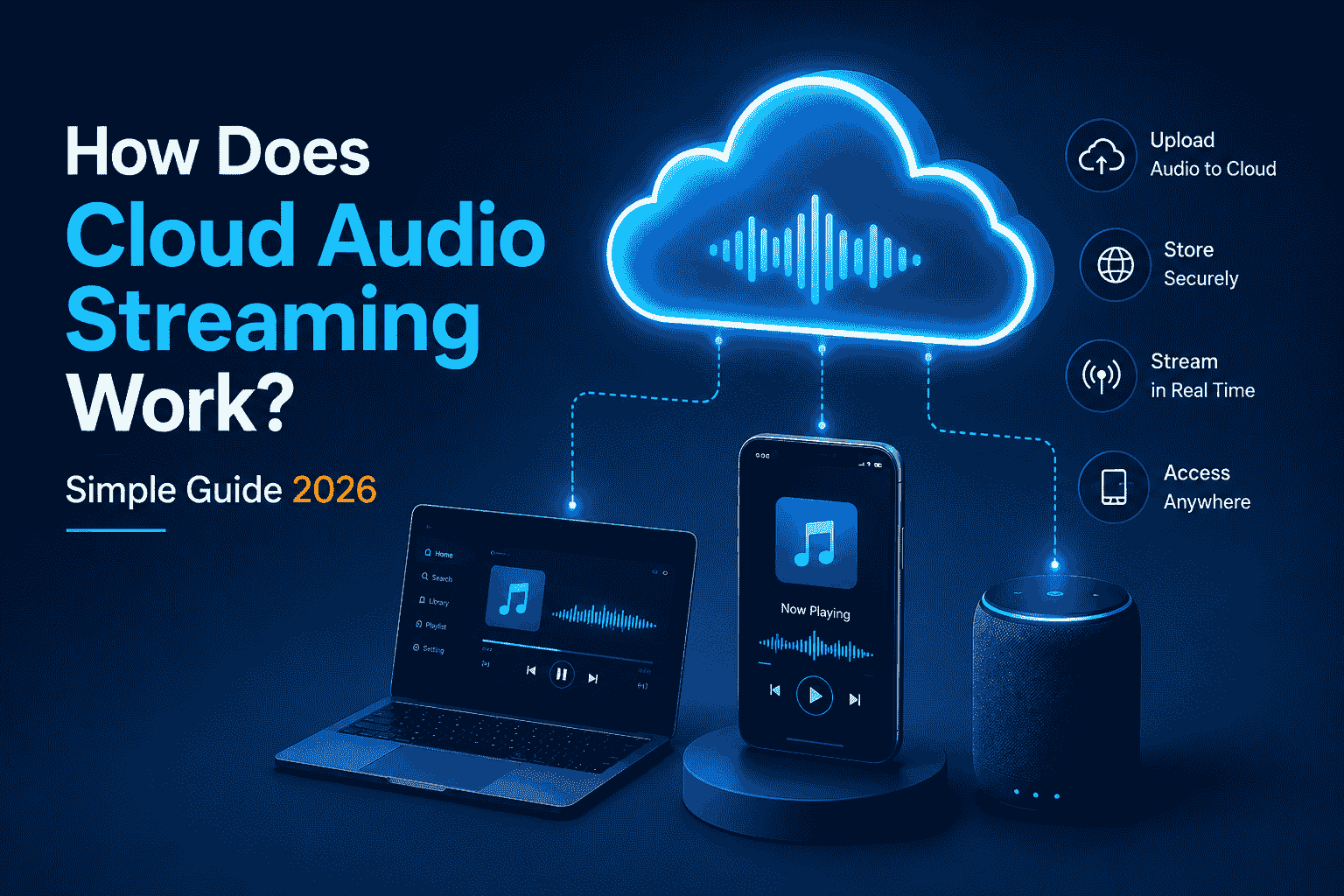
To understand how cloud audio streaming works, you also need to understand how the audio files themselves are stored before they ever reach your ears. When a musician, podcaster, or broadcaster uploads their audio content to a streaming platform, that content goes through a process called ingestion. During ingestion, the original audio file — which might be a high-quality WAV or FLAC file — is processed and converted into multiple different versions at different quality levels and in different file formats.
This is done because different listeners have different internet speeds and different devices, and serving a single ultra-high-quality file to everyone would cause buffering problems for people with slower connections. Once processed, all these different versions of the audio file are stored redundantly across multiple servers in different locations, so that even if one server fails or experiences problems, the audio is still available from other servers without any interruption to the listener.
Audio Compression and Formats in Cloud Streaming
A key part of understanding how cloud audio streaming works is understanding how audio files are compressed to make streaming practical. Raw, uncompressed audio files are enormous — a single three-minute song in uncompressed WAV format can be over 30 megabytes.
Streaming that file would require a very fast internet connection and would use up a lot of data very quickly. To solve this problem, streaming platforms use audio compression technologies that reduce the file size dramatically while preserving as much of the original sound quality as possible.
The most common audio streaming formats include MP3, AAC, OGG Vorbis, and OPUS. Each of these formats uses different mathematical algorithms to compress audio data by removing sounds that the human ear is least likely to notice, while keeping the sounds that matter most.
The result is a file that might be five to ten times smaller than the original but still sounds excellent through speakers or headphones. Most streaming platforms offer multiple quality options — like Spotify’s Normal, High, and Very High settings — which correspond to different levels of compression and different file sizes.
Adaptive Bitrate Streaming — The Smart Technology Behind Smooth Audio
One of the most clever technologies that makes cloud audio streaming work smoothly even on inconsistent internet connections is called adaptive bitrate streaming, often abbreviated as ABR. Anyone who has experienced a song suddenly going from crystal clear to muffled and then back to clear again has seen adaptive bitrate streaming in action.
Here is how it works — instead of sending audio at a fixed quality level regardless of your connection speed, the streaming platform constantly monitors how fast data is arriving at your device and automatically adjusts the quality of the audio it sends based on what your connection can handle at that moment. If your internet connection is fast and stable, the platform sends high-quality audio data.
If your connection slows down — perhaps because you moved to an area with weaker signal or because other apps are using your bandwidth — the platform automatically switches to a lower quality stream that can be delivered reliably without buffering. When your connection improves again, the quality automatically goes back up. This all happens automatically and seamlessly, often without you even noticing.
The Role of Audio Codecs in Cloud Streaming
When exploring How Does Cloud Audio Streaming Work, you will inevitably encounter the term codec, which stands for coder-decoder. A codec is a software algorithm that encodes audio data into a compressed format for efficient streaming and then decodes it back into playable sound on your device.
Different streaming platforms use different codecs, and the choice of codec has a significant impact on both sound quality and the amount of data required to stream it. Spotify primarily uses OGG Vorbis, Apple Music uses AAC, YouTube uses OPUS, and many platforms offer multiple codec options depending on the device and connection.
Newer codecs like OPUS are particularly impressive because they deliver very good audio quality at relatively low bitrates, making them excellent for streaming in situations where bandwidth is limited. Understanding codecs helps explain why the same song can sound slightly different on different streaming platforms even at the same stated quality level.
Real-Time vs On-Demand Cloud Audio Streaming
Not all cloud audio streaming is the same — there are two fundamentally different types that work in different ways. On-demand streaming, which is what most people think of when they think of music or podcast streaming, involves accessing pre-recorded content that is stored on cloud servers and played back whenever the listener chooses. The audio file exists before you press play and is simply retrieved and delivered to you on demand.
Live streaming, on the other hand, involves capturing audio in real time — like a live radio broadcast, a live concert, or a live podcast recording — and transmitting it instantly to listeners around the world.
Live audio streaming is technically more challenging because there is no pre-existing file to buffer from — the audio is being created and transmitted simultaneously, which means any technical problems affect all listeners immediately. Live streaming requires more sophisticated infrastructure and lower latency technology to work reliably.
Latency in Cloud Audio Streaming — What It Is and Why It Matters
Latency is one of the most important technical concepts in understanding how cloud audio streaming works, especially for live audio applications. Latency refers to the delay between when an audio signal is captured and when it actually reaches the listener’s ears. For on-demand music streaming, latency of a few seconds is completely acceptable — you might wait a moment for a song to start, but once it is playing, the experience is seamless.
For live audio streaming — like a live concert broadcast or a live radio show — even a few seconds of latency can be disruptive because the audio arrives noticeably behind the real-time event. And for interactive audio applications — like cloud-based music collaboration where musicians are trying to play together in real time over the internet — even a fraction of a second of latency can make synchronized performance impossible.
Reducing latency in cloud audio streaming is one of the most active areas of technological development in the industry right now, and significant progress has been made with technologies like WebRTC and low-latency HLS protocols.
How Spotify Uses Cloud Audio Streaming Technology
Spotify is the world’s largest music streaming platform and one of the best real-world examples of How Does Cloud Audio Streaming Work at massive scale. Spotify serves hundreds of millions of active listeners simultaneously, delivering tens of millions of different songs to users in over 180 countries.
To do this, Spotify uses a combination of Google Cloud Platform infrastructure, its own content delivery network, adaptive bitrate technology, and an enormous global network of cache servers that store the most popular songs close to the listeners who are most likely to play them.
When you play a popular song on Spotify, you are almost certainly receiving it from a server very close to your location that has cached that song in advance because it knew many people in your area would want to hear it. This intelligent caching system is one of the key reasons Spotify songs start playing so quickly — the server does not even need to fetch the file from central storage because it is already sitting nearby waiting for you.
Cloud Audio Streaming for Podcasts — How It Differs from Music Streaming
While the underlying technology is similar, cloud audio streaming for podcasts works somewhat differently from music streaming in a few important ways. Podcast audio files are typically hosted on dedicated podcast hosting platforms like Buzzsprout, Anchor, or Podbean, which store the audio files and generate RSS feeds that podcast directories like Apple Podcasts and Spotify use to find and distribute podcast content.
When you play a podcast episode, your podcast app sends a request directly to the hosting platform’s servers, which then streams the audio file to your device. Unlike music streaming, most podcast platforms do not use sophisticated adaptive bitrate technology because podcast audio files are simpler and smaller than music files, and the technology requirements are less demanding.
However, the growth of podcast streaming has led many major podcast hosting platforms to adopt CDN infrastructure and improve their streaming reliability significantly in recent years.
Security and Privacy in Cloud Audio Streaming
An important aspect of how cloud audio streaming works that many listeners never think about is how their listening data is handled by streaming platforms. When you stream audio through any cloud platform, information about what you listen to, when you listen, how long you listen, and where you are when you listen is all collected and stored by the platform.
This data is used to power recommendation algorithms that suggest new music and podcasts you might enjoy, but it is also valuable commercial data that platforms use for advertising and business purposes. Most streaming platforms encrypt the connection between your device and their servers, which protects your listening session from being intercepted by third parties. However, the platform itself always has full visibility into your listening habits.
Understanding this aspect of cloud audio streaming helps you make more informed decisions about which platforms you choose to use and what privacy settings you activate.
The Future of Cloud Audio Streaming Technology
Cloud audio streaming technology is developing rapidly, and the next few years promise some exciting changes that will make the experience even better for both listeners and creators. Spatial audio and immersive sound formats are becoming increasingly common on streaming platforms, creating a three-dimensional listening experience that feels far more realistic and engaging than traditional stereo audio.
AI-powered audio enhancement is being integrated into streaming platforms to automatically improve the quality of older recordings and optimize audio for different listening environments.
Ultra-low latency streaming technology is making real-time cloud-based music collaboration — where musicians in different countries can play together with minimal delay — increasingly practical. And as 5G networks continue to expand globally, the bandwidth and reliability of mobile internet connections will make high-quality cloud audio streaming accessible to listeners in more places than ever before.
Why Cloud Audio Streaming Changed Everything
Looking back at the transformation that cloud audio streaming has brought to the audio world, it is hard to overstate how profound the change has been. Before streaming existed, people had to physically purchase music — on vinyl records, cassette tapes, CDs — or download digital files to their devices before they could listen.
The idea that you could instantly access virtually any song ever recorded, from any device, anywhere in the world, without owning a single physical copy, would have seemed like science fiction not that long ago.
Cloud audio streaming made that reality possible, and in doing so it transformed the music industry, created the podcast boom, made audio content more accessible to people in every part of the world, and opened up new creative possibilities for artists and creators that simply did not exist before. Understanding how it works helps us appreciate both the remarkable technology behind it and the enormous creative ecosystem it has made possible.
Final Thoughts
Now that you understand How Does Cloud Audio Streaming Work, you can appreciate the extraordinary complexity and ingenuity that happens every time you press play on your favorite song or podcast. From the moment you tap that button to the moment sound reaches your ears, dozens of sophisticated technologies work together seamlessly — servers, CDNs, codecs, adaptive bitrate algorithms, content delivery networks, and more — all in a fraction of a second.
Cloud audio streaming is one of the great technological achievements of the modern era, and it continues to get better, faster, and more accessible with every passing year. Visit cloudconnectedaudio.org for more in-depth guides, reviews, and news about cloud audio technology and everything happening in the world of connected sound.