Introduction
Open ear earbuds 2026 are wireless earbuds that rest outside your ear canal instead of sealing it shut. They use air conduction or bone conduction to deliver sound while keeping you aware of your surroundings. In 2026, they’re more popular than ever thanks to better sound, longer battery life, and a design that’s safer and more comfortable for all-day wear.
Open ear earbuds have quietly become one of the biggest shifts in personal audio, and 2026 is the year they’ve truly gone mainstream. For years, most people assumed that good sound meant plugging your ears completely shut. That idea is changing fast. More runners, cyclists, office workers, and everyday listeners now want to enjoy their music or podcasts without cutting themselves off from the world around them, and open ear earbuds make that possible.
This guide breaks down everything you need to know about open ear earbuds in 2026. You’ll learn how they work, who they’re best for, what features actually matter, and which models stand out this year. By the end, you’ll know whether this new style of earbud fits your lifestyle and how to pick a pair that gives you real value for your money.
Whether you’re a fitness lover, a busy professional, or someone who simply finds traditional earbuds uncomfortable, this article will help you make a smart, confident choice.
What Are Open Ear Earbuds?
Open ear earbuds are wireless earbuds that sit just outside or around your ear rather than inside your ear canal. Traditional earbuds push a silicone tip into your ear to block outside noise and seal in sound. Open ear earbuds do the opposite. They leave your ear canal completely open, which means you can hear your music and the world around you at the same time.
Most open ear earbuds use a small speaker that hovers near the entrance of your ear, or they clip gently onto the outer ridge of your ear. Some use bone conduction technology, which sends sound vibrations through your cheekbones instead of through the air. Either way, the goal is the same: give you clear audio without covering or plugging your ears. This design has been around for a while in niche products, but the technology has improved so much that 2026 models finally sound good enough to compete with regular earbuds.
Why Open Ear Earbuds Are Trending in 2026
Open ear earbuds are trending in 2026 because they solve real problems that traditional earbuds never could. The main reason is safety and awareness. People who run, cycle, or walk in busy areas want to hear traffic, other people, and their surroundings while still enjoying their audio. Sealed earbuds block all of that out, which can be dangerous outdoors.
Another big reason is comfort. Many people find in-ear tips uncomfortable or even painful after long periods. Because open ear earbuds don’t push anything into your ear canal, they feel far lighter and cause less ear fatigue. There’s also a growing awareness around ear health. Sweaty, sealed earbuds can trap moisture and bacteria, and some listeners worry about long-term hearing damage from sound blasted directly into a closed canal.
Finally, the technology has simply caught up. Earlier open ear models were often quiet, tinny, and leaked sound to everyone nearby. The 2026 generation offers richer bass, smarter directional speakers, and better battery life, which has pushed them from a niche gadget into a genuine everyday choice.
How Do Open Ear Earbuds Work?
Open ear earbuds work using one of two main technologies: air conduction or bone conduction. Air conduction is the most common approach in 2026. A tiny, precisely angled speaker sits close to your ear opening and directs sound waves straight into your ear canal without physically blocking it. The speaker is tuned to focus the sound toward you so that people around you hear as little as possible.
Bone conduction works differently. Instead of using the air, it sends gentle vibrations through the bones of your skull, usually resting against your cheekbones just in front of your ears. These vibrations travel directly to your inner ear, letting you “hear” the sound without anything covering your ears at all. Bone conduction is especially popular with swimmers and runners because it leaves the ears totally free.
Both methods connect to your phone or device through Bluetooth, just like standard wireless earbuds. The clever part is the engineering that keeps the sound clear and focused while your ears stay open to the outside world.
Benefits of Open Ear Earbuds
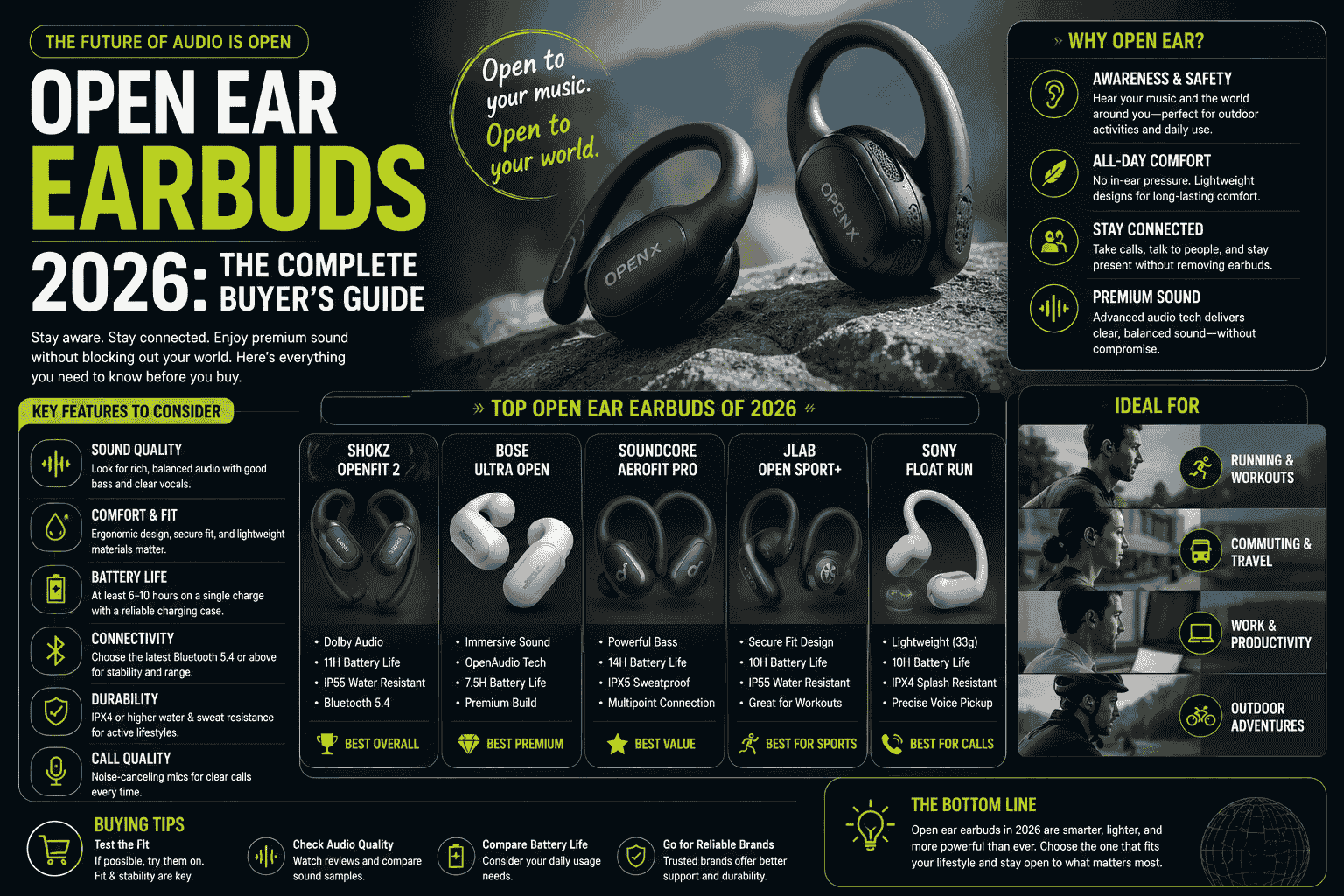
The benefits of open ear earbuds go well beyond just staying aware of your surroundings. Here are the main advantages that make them worth considering in 2026:
- Situational awareness: You can hear traffic, announcements, and conversations while still enjoying your audio, which makes them far safer for outdoor activities.
- All-day comfort: With nothing jammed into your ear canal, you can wear them for hours without soreness, pressure, or that “plugged up” feeling.
- Better ear health: Leaving your ear canal open reduces trapped moisture and lowers the risk of irritation, wax buildup, and infections that sealed earbuds can cause.
- Great for glasses and helmets: Many open ear designs clip onto the ear or wrap around it, working smoothly alongside sunglasses, prescription glasses, and cycling helmets.
- Easy conversations: You can talk to someone without ripping an earbud out, which is handy at work, in stores, or when a family member calls your name.
- Secure fit for sport: Because they hook or clip onto your ear, many models stay put during running, jumping, and intense workouts.
Who Should Use Open Ear Earbuds?
Open ear earbuds are ideal for people who value awareness and comfort over total noise isolation. Runners and cyclists top the list, since staying alert to traffic and other people can genuinely keep them safe. If you exercise outdoors regularly, this style of earbud is one of the smartest choices you can make in 2026.
They’re also a great fit for office workers and remote employees who need to stay reachable. You can keep one ear on a podcast or background music while still hearing a coworker, a doorbell, or a child in the next room. Parents, in particular, love being able to enjoy their audio without feeling cut off from what’s happening at home.
On the other hand, open ear earbuds may not be the best pick if you crave deep, immersive bass or need to block out loud environments like airplanes and busy trains. Frequent flyers and people who want total silence for focus will still be better served by noise-cancelling in-ear or over-ear headphones. Choose open ear earbuds if awareness, comfort, and all-day wear matter more to you than deep bass and heavy noise isolation.
Top Features to Look for in Open Ear Earbuds 2026
When shopping for open ear earbuds in 2026, a few features separate the great models from the average ones. Sound quality should be your first priority, especially how well the earbuds handle bass, since open designs naturally struggle more with low frequencies. Look for models that advertise improved bass drivers or dedicated low-frequency tuning.
Fit and stability come next. If you plan to work out, choose a secure ear-hook or clip design that won’t slip when you sweat or move quickly. Water and sweat resistance, usually shown as an IP rating like IPX5 or higher, is essential for sport use. Battery life matters too, and the best 2026 models offer long single-charge playtime plus extra charges from the case. Finally, check for multipoint Bluetooth so you can connect to your phone and laptop at the same time, along with a reliable app for adjusting sound and controls.
Best Open Ear Earbuds of 2026
The best open ear earbuds of 2026 combine strong sound, secure fit, and long battery life. While the exact “best” pair depends on your needs, a few categories help you decide:
- Best for runners and cyclists: Look for lightweight ear-hook models with a strong IP rating, secure grip, and clear voice pickup for calls on the go.
- Best for office and everyday use: Choose clip-style earbuds that stay discreet, connect to multiple devices, and offer comfortable all-day wear.
- Best for swimmers: Bone conduction models with full waterproofing and built-in storage are the standout choice, since regular Bluetooth struggles underwater.
- Best budget option: Entry-level air conduction earbuds now offer surprisingly good sound and solid battery life at a lower price point.
- Best premium option: High-end models deliver the richest bass, smartest sound-leakage control, and the longest battery life, ideal for listeners who want the full experience.
Choose a premium model if sound quality and features matter most, or a budget model if you simply want to try the open ear style without a big investment.
Sound Quality of Open Ear Earbuds
Sound quality is where open ear earbuds have improved the most heading into 2026. In the past, the biggest complaint was weak bass and thin, tinny audio, because there was no seal to trap and boost low frequencies. Manufacturers have worked hard to fix this. Newer models use larger, better-tuned drivers and clever software that boosts bass without distorting the rest of the sound.
That said, it’s important to set realistic expectations. Open ear earbuds still can’t match the deep, punchy bass of a well-sealed in-ear model, simply because of how the technology works. What they offer instead is a natural, airy sound that many people find pleasant for podcasts, calls, and everyday music. In quiet rooms, the top 2026 models sound genuinely good. In loud environments, though, background noise can compete with your audio, since your ears aren’t sealed. For most casual listening and outdoor use, the sound is more than good enough, but audiophiles chasing studio-level detail should keep their expectations in check.
Comfort and Fit
Comfort is one of the strongest selling points of open ear earbuds. Since nothing is pushed into your ear canal, you avoid the pressure and soreness that many people feel with traditional tips. Most 2026 models weigh very little and rest gently on or around the ear, so you can often forget you’re wearing them.
There are two main fit styles. Ear-hook designs loop over the top of your ear, offering a very secure hold that’s great for sport. Clip-on designs pinch softly onto the outer edge of your ear, giving a lighter, more discreet feel that suits office and casual use. The right choice depends on your activity and ear shape, so if possible, it helps to try a style before committing.
Open ear earbuds are also a blessing for glasses wearers, who often struggle to fit in-ear or over-ear options comfortably alongside their frames.
Battery Life and Charging
Battery life on open ear earbuds has improved noticeably in 2026. Many models now offer around six to ten hours of playtime on a single charge, with the charging case providing several full recharges on top of that. This means a good pair can easily last through a full day of work, a long run, or a weekend trip without needing a plug.
Most cases charge over USB-C, and a growing number now support wireless charging, so you can drop them on a pad without fiddling with cables. Fast charging is another welcome feature, with some models giving you an hour or more of playtime from just a few minutes plugged in. If long battery life is a priority for you, check both the single-charge figure and the total battery life including the case before buying.
Connectivity and Compatibility
Open ear earbuds connect to your devices using Bluetooth, and the 2026 models mostly ship with newer Bluetooth versions that offer stable connections and lower power use. This means fewer dropouts, faster pairing, and better efficiency than older earbuds.
Compatibility is broad. Open ear earbuds work with iPhones, Android phones, tablets, laptops, and most Bluetooth devices, so you don’t need to worry about brand lock-in. One feature worth looking for is multipoint connectivity, which lets you stay paired to two devices at once, such as your phone and your laptop. This makes it easy to switch from a work call on your computer to a song on your phone without re-pairing. Companion apps are also common now, letting you tweak the sound, update firmware, and customize your touch controls.
Open Ear Earbuds vs. Traditional Earbuds
Open ear earbuds and traditional earbuds serve different needs, and knowing the difference helps you pick the right one. Traditional in-ear earbuds seal your ear canal, which delivers stronger bass, better noise isolation, and often more powerful active noise cancellation. If you want to disappear into your music or block out a noisy commute, sealed earbuds still win.
Open ear earbuds trade some of that sound isolation for awareness and comfort. They let you hear your surroundings, feel lighter on your ears, and stay comfortable for hours. The table below sums up the key differences:
|
Feature |
Open Ear Earbuds |
Traditional Earbuds |
|---|---|---|
|
Awareness of surroundings |
High |
Low |
|
Bass and noise isolation |
Moderate |
Strong |
|
Comfort for long wear |
Very high |
Varies |
|
Safety for outdoor sport |
Excellent |
Limited |
|
Best for |
Runners, cyclists, office use |
Commuters, focus, immersive listening |
Choose open ear earbuds if awareness and comfort matter most. Choose traditional earbuds if you want deep bass and strong noise blocking.
Are Open Ear Earbuds Safe?
Open ear earbuds are widely considered a safer option than traditional earbuds for two main reasons. First, they keep you aware of your surroundings. Because your ears stay open, you can hear traffic, cyclists, alarms, and people around you, which is a real advantage when exercising outdoors or walking in busy areas.
Second, many experts believe the open design may be gentler on ear health. Sealed earbuds can trap heat, sweat, and bacteria in the ear canal, which can lead to irritation or infection over time. Open ear models avoid this by leaving the canal free and ventilated. They may also encourage lower listening volumes in some cases, though it’s still important to keep the volume at a sensible level to protect your hearing. As with any audio device, safe listening habits matter most, but the open ear design gives you a helpful head start.
Price Range and Value for Money
Open ear earbuds in 2026 come in a wide price range to suit different budgets. Entry-level models are now genuinely affordable and offer surprisingly capable sound, secure fit, and decent battery life, making them a low-risk way to try the open ear style. Mid-range options add better sound tuning, longer battery life, stronger water resistance, and useful app features. Premium models sit at the top, delivering the richest sound, the best sound-leakage control, and the most advanced features.
When judging value, don’t just look at the price tag. Consider how you’ll use the earbuds, how long they’ll last, and which features actually matter to you. For a runner, a secure fit and high water resistance are worth paying for. For office use, comfort and multipoint connectivity may matter more. The best value pair is the one that matches your real needs, not simply the cheapest or the most expensive on the shelf.
Final Thoughts on Open Ear Earbuds in 2026
Open ear earbuds have grown from a niche gadget into a smart, mainstream choice, and 2026 is the year they’ve hit their stride. They offer a rare mix of comfort, safety, and awareness that traditional earbuds simply can’t match, all while sounding better than ever before. For runners, cyclists, office workers, parents, and anyone who finds in-ear tips uncomfortable, they’re well worth a serious look.
The key is to match the earbuds to your lifestyle. Think about where and how you’ll use them, decide which features matter most, and set a budget that reflects your needs. If awareness and all-day comfort top your list, open ear earbuds are one of the best upgrades you can make this year. Ready to make the switch? Compare a few models against the features in this guide and pick the pair that fits your life best.
Frequently Asked Questions
What are open ear earbuds and how are they different from normal earbuds?
Open ear earbuds sit just outside your ear instead of inside your ear canal. Unlike normal earbuds, they don’t seal your ears shut, so you can hear your music and your surroundings at the same time. This makes them more comfortable for long wear and safer for outdoor activities.
Are open ear earbuds good for running and workouts?
Yes, open ear earbuds are excellent for running and workouts. Their secure ear-hook or clip design keeps them in place during movement, and they let you stay aware of traffic and your surroundings. Look for a model with a water-resistance rating of IPX5 or higher for sweaty sessions.
Do open ear earbuds have good sound quality in 2026?
Open ear earbuds sound much better in 2026 than earlier models, with improved bass and clearer audio thanks to upgraded drivers and smarter tuning. However, they still can’t match the deep bass and noise isolation of sealed in-ear earbuds, so they’re best for casual listening, podcasts, and outdoor use rather than studio-level detail.
How much do open ear earbuds cost in 2026?
Open ear earbuds in 2026 range from affordable entry-level models to premium high-end options. Budget pairs are a low-risk way to try the style, while premium models offer richer sound, better battery life, and advanced features. The best value comes from matching the earbuds to how you actually plan to use them.
Are open ear earbuds safe for your ears?
Open ear earbuds are considered a safe choice because they keep your ear canal open and ventilated, reducing trapped sweat and bacteria. They also keep you aware of your surroundings, which is safer outdoors. As always, keeping the volume at a sensible level is the most important step for protecting your hearing.